
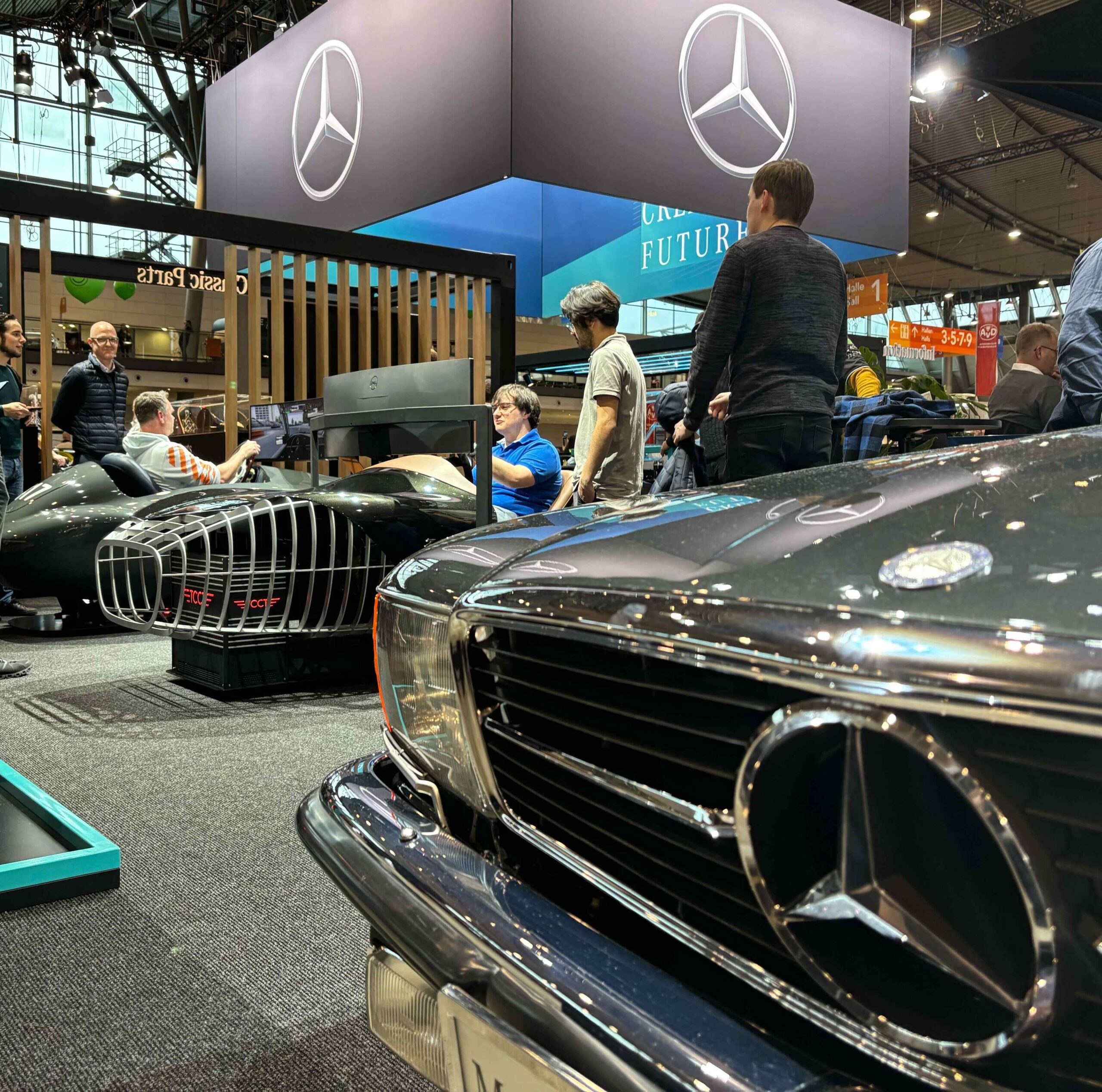
This past weekend, the Stuttgart exhibition center became the epicenter of road transport history. Mercedes-Benz Trucks Classic inaugurated the “130 Years Trucks” exhibition at Retro Classics 2026, a showcase that remained open to the public from February 19th to 22nd and which, according to the organization’s forecasts, received around 70,000 visitors.
In a 700-square-meter stand located in Hall 10, the three-pointed star decided to celebrate its anniversary in a big way, bringing back to the present the machines that forever changed global logistics.
It was not just any year for the German firm: 130 years after Gottlieb Daimler presented his revolutionary invention, the company looked to the past with pride, but also reaffirmed its role as an architect of the future of transport.
The undisputed star of the commemoration was the faithful reconstruction of that pioneering 1896 vehicle. With its rear-mounted “Phoenix” two-cylinder engine producing just four horsepower and a displacement of 1.06 liters, that primitive truck, with the appearance of a motorized stagecoach, has little or nothing to do with the colossal machines that ply our highways today. Its belt transmission and chain steering evoke an artisanal era of automotive engineering, but even in that rudimentary design, surprisingly advanced engineering concepts were present. Daimler integrated the planetary hub reduction axle, a technical solution that, adapted and evolved, persists in today’s heavy-duty trucks, demonstrating the soundness of that foundational genius.
The rapid evolution of that invention was not long in coming, and the exhibition in Stuttgart reflected it with pieces that traced the evolutionary line. Just two years later, Daimler had already moved the engine to the front to gain load capacity and was testing its prototypes in real-world conditions at brick factories. By 1899, the first trucks were already being exported to England and France, prevailing over steam vehicles and initiating an international expansion that would be consolidated at the 1900 Paris Universal Exposition. Among the jewels on display were the first Daimler truck with a cardan shaft from 1899, currently under restoration at the Technik Museum Speyer, as well as post-war models such as the Mercedes-Benz L 4500, LP 608, and L 1113, authentic witnesses to European reconstruction.
But the look to the past at Retro Classics also served to celebrate other contemporary milestones. The exhibition space dedicated a place of honor to the three decades of the Mercedes-Benz Actros. Introduced in 1996, the Actros represented a conceptual revolution by introducing advanced electronics in heavy transport with its CAN data bus and electronic braking systems, transforming the truck into an intelligent and connected work tool. In 2006, another key advance arrived with Active Brake Assist, a precursor to today’s active safety systems, which also celebrated its anniversary this year. The exhibition also included the 80th anniversary of the iconic Unimog — with units from 1946 and 1978 — and the 75th anniversary of Setra, represented by a splendid 1954 Setra S 8, a symbol of the revolutionary self-supporting bus concept.
And if the 1996 Actros was a milestone, its natural evolution, the eActros 600 Safety Truck, displayed alongside its ancestors, demonstrated just how far innovation has come. Equipped with a fusion of 270-degree sensors, Active Brake Assist 6, and Active Sideguard Assist 2, this electric truck not only represents the future of sustainable mobility but also embodies the promise of active safety that even exceeds planned legal standards. It was the most modern link in an unbroken chain of progress that began with that 4 HP vehicle, and visitors could verify this every day at 12:30 p.m., when the engines of the 1896 truck and a Race Truck were started alternately, offering an impressive acoustic experience that connected 130 years of history in a matter of seconds.
“130 years of trucks represent 130 years of pioneering spirit and innovation,” summarized Jean-Marc Diss, Head of Global Sales and Marketing at Mercedes-Benz Trucks, during the opening. The executive stressed that this legacy is, above all, a motivation to continue developing transport solutions that benefit customers and society as a whole. Gazing at the image of that fragile 1896 truck next to the imposing eActros 600, attendees could not help but marvel at the dizzying technological progress. However, what remains unchanged is the drive to transform, to go further, to connect destinations and people, according to some digital publications including Revista Motor 16. In a world demanding decarbonization and efficiency, Mercedes-Benz Trucks demonstrated in Stuttgart that the best way to honor 130 years of history is to continue looking resolutely forward, with the same courage as that first journey that changed transport forever.
Have any thoughts?
Share your reaction or leave a quick response — we’d love to hear what you think!
-
 0
0
-
 0
0
-
 0
0
-
 0
0
-
 0
0
