
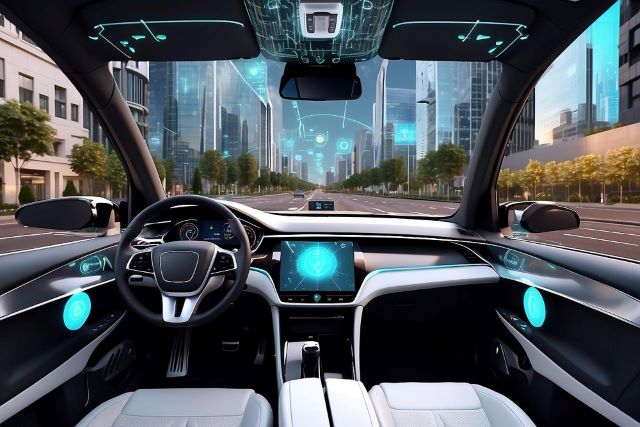
The news that Madrid will be the stage chosen by Uber to launch its driverless taxi service in 2026 is not just a simple technological anecdote, but an event that marks a before and after in the history of transportation in Spain. That the capital becomes a special venue for this type of initiative speaks both to its position as an urban benchmark in innovation and to the maturity that a technology is reaching that, until recently, seemed reserved for science fiction films. This milestone will not only transform the way citizens move around, but also raises fundamental questions about the future of our cities, employment, and the relationship between humans and machines. We are undoubtedly facing the dawn of a new era of mobility.
An autonomous vehicle is, in essence, a robot on wheels that has learned to drive. Far from being a conventional car from which the steering wheel has been removed, it is a complex system that perceives the world around it and makes decisions in fractions of a second. To get an idea, these vehicles do not “see” like us, but rather build a digital representation of their environment in real time. This allows them to circulate without the intervention of a human driver, interpreting traffic signs, anticipating the movements of pedestrians and other vehicles, and navigating the urban fabric with millimeter precision.
The operation of these technological marvels rests on three fundamental pillars that imitate, and in many cases surpass, human capabilities. The first is the sensor system, the vehicle’s “senses”: cameras that recognize traffic lights and signs, radars that measure the speed of objects, and the sophisticated LiDAR, which uses laser pulses to create an accurate three-dimensional map of everything surrounding the car. The second pillar is the “brain,” a powerful processing unit where artificial intelligence analyzes the stream of data, identifies pedestrians, predicts their possible movements, and decides whether to accelerate, brake, or turn. The third is the actuators, the “hands and feet” that physically execute those decisions on the steering wheel, accelerator, and brakes.
The service that Uber will implement in Madrid will be a practical example of Level 4 autonomy, according to the international classification. This means that the vehicles will be capable of driving themselves without the need for human supervision, but exclusively within a delimited geographical area and under predefined conditions, most likely in the city center. For the user, the experience will be as simple as opening the app they already know, requesting a ride, and watching a driverless car arrive. The invisible magic will fall to companies like Moove Cars, which will manage the fleet, and to the deep learning algorithms that improve with every kilometer traveled.
However, the path to this reality is not without obstacles. The challenges are as complex as the technology itself. On a technological level, adverse weather phenomena such as heavy rain or snow can interfere with the sensors. On the legal and ethical front, difficult questions arise: who is responsible in the event of an accident? How should the vehicle be programmed to face an inevitable moral dilemma? And perhaps the most human challenge of all: social acceptance. Convincing citizens to get into a driverless vehicle will require not only impeccable safety but also a deep exercise in education and trust.
Despite these challenges, the potential benefits are so transformative that they explain why large technology companies are investing huge amounts of money in this race. The promise is of much safer mobility, by eliminating human error, the cause of the vast majority of traffic accidents. A future with more livable cities is also envisioned, where the need for huge parking lots is reduced and traffic flows more smoothly thanks to vehicle-to-vehicle communication. But above all, it opens the door to unprecedented independence for elderly people or those with reduced mobility, who will be able to get around without depending on anyone.
In short, the arrival of autonomous taxis in Madrid in 2026 is much more than the launch of a new service. It is the materialization of a long-cherished technological dream and the first step towards a revolution that will redefine the concept of public transport. Madrid is preparing to be the showcase for a future that is already here, a future where artificial intelligence will take the wheel to take us, hopefully, towards a destination of safer, more efficient, and more accessible cities for everyone. The eyes of the entire technology sector will be on the Spanish capital, eagerly awaiting the outcome of this exciting mobility experiment.
Have any thoughts?
Share your reaction or leave a quick response — we’d love to hear what you think!
-
 0
0
-
 0
0
-
 0
0
-
 0
0
-
 0
0
