
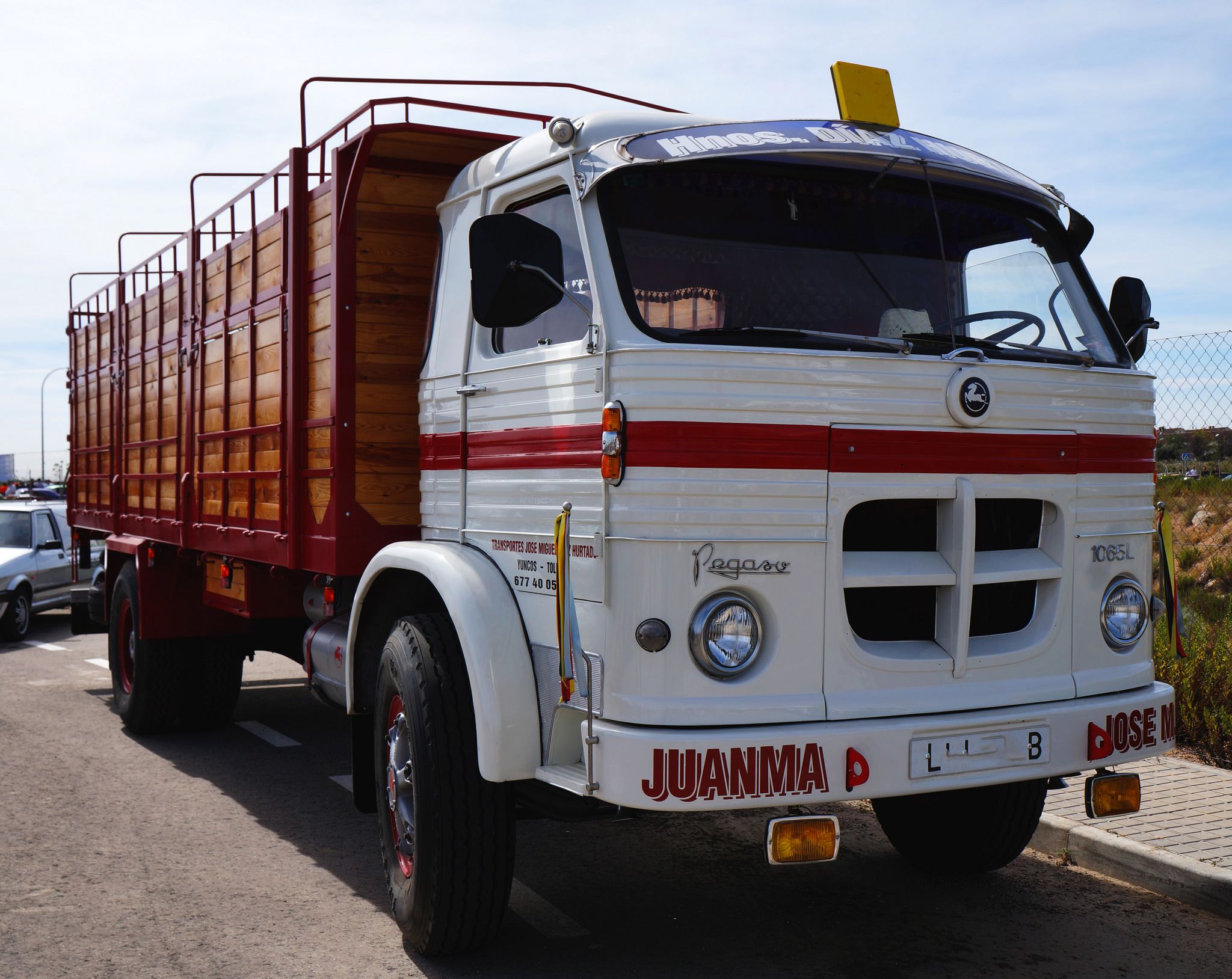
The roar of the engines that built a country takes us by the hand through a history we do not forget; it is part of the nation’s industrial lineage.
In Spain of the last century, marked by autarky and subsequent developmentalism, the industrial and road landscape cannot be understood without the trucks that saw the light in its factories. Far from being mere vehicles, the Pegaso, Barreiros, and Ebro were the protagonists of a technological and business epic that transformed the national economy. These were times of isolation and necessity, where the capacity to create a heavy vehicle from scratch or with ingenious adaptations was almost an act of industrial sovereignty. These machines not only transported goods but also carried on their frames the weight of a country seeking to modernize at all costs.
The story begins with Pegaso, the winged horse of public industry. Born in 1946 from the ashes of Hispano-Suiza under the umbrella of the INI, the Empresa Nacional de Autocamiones (ENASA) had an almost patriotic mission: to provide industrial vehicles to a blocked nation. Its first model, known as “Mofletes,” gave way in 1947 to the Pegaso II, laying the foundations for a brand that would become a standard-bearer. Models like the Pegaso Comet, the result of collaboration with British Leyland, stood out for their robustness and reliability, becoming the backbone of Spanish transport for decades. They were tough trucks, designed for difficult roads and mechanics that prioritized solvency over luxury.
However, the public monopoly soon had a private counterpoint from a self-taught genius: Eduardo Barreiros. This Galician businessman, starting from a family workshop, revolutionized the diesel engine with an ingenious system to transform gasoline engines, giving life to Barreiros Diésel S.A. in 1954. His trucks, such as the mythical Azor or the Super Azor, burst into the market with reliability and a competitive price that challenged Pegaso’s leadership. Barreiros represented the impetus of industrial capitalism in a hostile environment, and his vehicles, with simple and noble mechanics, won the favor of transporters who needed infallible work tools.
The third leg of this industrial tripod was Ebro, a brand that emerged in 1954 after the nationalization of the old Ford factories in Barcelona, giving rise to Motor Ibérica. If Pegaso was the public banner and Barreiros the combative entrepreneur, Ebro represented adaptation and diversification. Its first models drew directly from British Ford technology, such as the Thames Trader, but soon expanded by absorbing other companies like Fadisa or Avia. This strategy allowed them to offer a vast catalog, from vans like the F-100 to medium trucks like the B-35, which fit like a glove to the needs of small commerce and agriculture.
Characteristically, these vehicles shared a common DNA: simplicity and strength. They were trucks with powers that today would seem laughable, often between 90 and 170 HP, but they moved tons of cargo through mountain passes thanks to multiple gears and reducers. Driving them was an art; the famous Pegaso 1060 “palanquero” required handling two gear levers simultaneously to obtain the eight ratios of its transmission. Ergonomics were almost non-existent, but the mechanics, mostly of their own origin or under highly adapted licenses, allowed any village mechanic to repair them with basic tools.
The 1960s were the golden age of this tripartite competition. Pegaso, with models like the 3046; Barreiros, with its alliance with Chrysler that gave way to the Dodges; and Ebro, with its sustained growth, not only supplied the domestic market but also began to look to foreign markets. This technological and commercial struggle was the breeding ground that modernized Spanish roads. However, the end of the century brought the harsh reality of globalization. Spain’s entry into the EEC and the gigantic investments necessary to compete made the status quo unsustainable.
The outcome is well known to enthusiasts: Barreiros was absorbed by Chrysler and later integrated into PSA; Pegaso succumbed in 1990 to the Italian Iveco, ceasing production in 1995; and Ebro, after falling into the hands of Nissan in the 80s, saw its brand diluted. It was the end of an era when trucks had their own name and Spanish accent. Today, looking back and remembering the Pegaso Comet, the Barreiros Azor, or the Ebro B-45 is more than an exercise in nostalgia. It is recognizing the value of an industry that, with more ingenuity than means, knew how to build the vehicles that literally transported Spain from the postwar period to modernity.
Have any thoughts?
Share your reaction or leave a quick response — we’d love to hear what you think!
-
 0
0
-
 0
0
-
 0
0
-
 0
0
-
 0
0
