
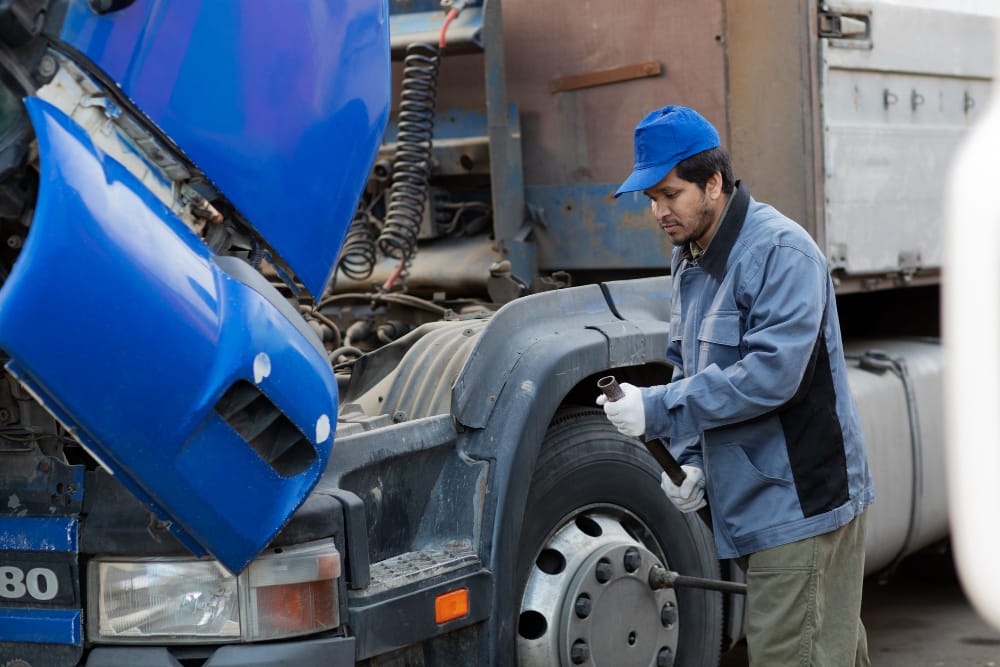
When winter unleashes its fury on the European continent, roads transform into a titanic challenge, especially for heavy goods vehicles. It is not just about driving; it is about surviving an environment where snow, freezing rain, blizzards, and sub-zero temperatures test every component of the truck or bus. For a haulier, facing mountain passes and uneven roads in these conditions is no small task, and the margin for error narrows dramatically. Preparation begins long before the first flake falls, in a workshop where meticulousness and foresight become the best allies to guarantee not only the delivery of goods but the safety of everyone on the road.
One of the fundamental pillars of this preparation is, without a doubt, the electrical system and, more specifically, the batteries. As the thermometer plummets, the starting capacity of a diesel engine becomes severely compromised. Low temperatures thicken lubricants and increase internal resistance, demanding a titanic effort from the batteries. An experienced haulier knows that checking their state of charge, their terminals, and their age is not an option, but an obligation. A weak battery in the middle of a blizzard at a mountain pass can mean being stranded, a scenario that, besides the intrinsic danger, can lead to rescue costs and multi-million-dollar delays. Reliability in the power supply is the first heartbeat that keeps the road giant alive.
In parallel, the vehicle’s dialogue with the asphalt (or with the layer of ice covering it) falls on an equally critical element: the tires. In winter, grip is everything. The legal tread depth is not enough; specific rubber is required, designed to remain flexible at sub-zero temperatures and to effectively evacuate snow and slush. For a large vehicle, whose weight and length magnify any loss of control, good winter tires are the difference between safely negotiating an icy curve or becoming an out-of-control trailer. Pressure must be constantly monitored, as thermal variations alter it, and any irregularity can compromise stability on roads that are already treacherous.
Beyond these two pillars, winter maintenance extends to a thorough check of vital systems. The brakes, of course, must be in optimal condition, paying special attention to possible freezing in the air lines. The heating system is not a mere luxury; it is essential for demisting the windows and ensuring visibility, as well as for the driver’s comfort and alertness during long waiting hours or traffic jams. Fluids, from engine antifreeze to windshield washer fluid, must have the correct concentration to avoid solidifying. Even elements like the windshield wipers and lights (headlights, rear lights, fog lights) take on supreme importance for seeing and being seen in the twilight and blinding whiteness of a storm.
Ultimately, for a haulier facing the harsh European winter, preparing the vehicle is an act of responsibility that goes beyond regulations. It is a comprehensive process where checking the batteries and tires—those often forgotten elements in temperate climates—is placed at the center of the safety strategy. Every component checked, every system tested, is a bet on the continuity of the journey, on the integrity of the cargo, and most importantly, on the life of the driver and those who share the road. In the fight against the elements, a perfectly maintained heavy goods vehicle is not just a work tool, but a rolling refuge and an indispensable ally.
Have any thoughts?
Share your reaction or leave a quick response — we’d love to hear what you think!
-
 0
0
-
 0
0
-
 0
0
-
 0
0
-
 0
0
