
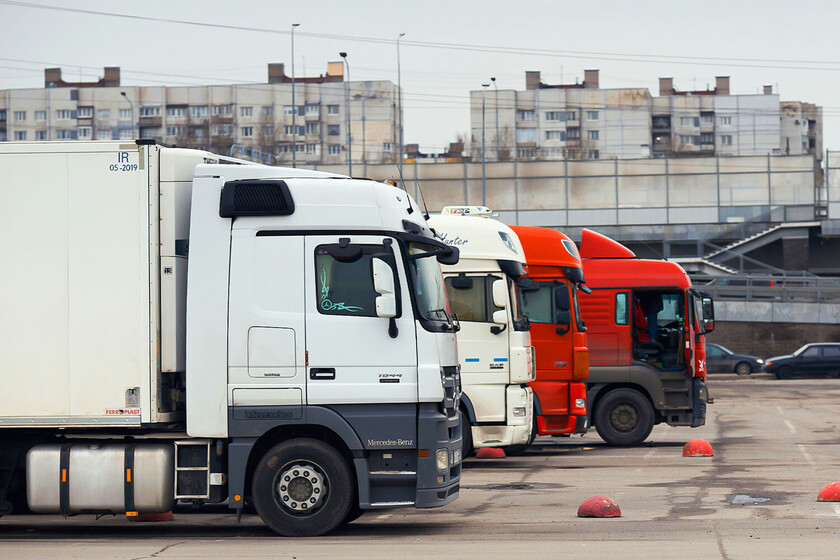
The Ministry of Industry has thrown a temporary lifeline to the road transport sector. With a resolution published in the Official State Gazette (BOE), it has established that, throughout 2026, carriers will be able to homologate their trucks with five or more axles to 44 tons through a streamlined, no-cost procedure: a simple annotation on the vehicle’s technical file during its MOT (Periodic Technical Inspection). This measure, effective until January 1, 2027, prevents the process from being classified as a “major modification,” a path that is slower, more expensive, and burdened with paperwork.
The decision solves an administrative problem that sector associations, such as Fenadismer, had been denouncing for months. The initial interpretation of the regulation allowing circulation with 44 tons (in force since October 2023 for most vehicles) was rigid: it only permitted the annotation during the “first periodic technical inspection” after the regulation came into effect. If a truck passed that MOT without requesting it, it later had to face the complex modification procedure. An obstacle that Fenadismer labeled as “restrictive and irrational.”
This administrative patch arrives amidst intense debate about the real consequences of the new capacity. While shippers see an opportunity to improve logistical efficiency, many carriers fear it will translate into more cargo without a fair review of rates. A study by the University of the Basque Country quantifies this impact: the cost per kilometer of a fully loaded truck may have increased between 2.5% and 10%. The shippers’ association (ACE) states they are aware of the need to update contracts, but carriers miss a legal mechanism to guarantee it.
While homologation is being facilitated, inspection is gearing up for control. The Ministry of Transport has indicated that its 2026 inspection plan will prioritize verifying compliance with the new weight limits, reminding that there will be no tolerance margin if the vehicle’s technical capacity is exceeded.
In short, the Ministry of Industry is unclogging a bureaucratic bottleneck with a pragmatic solution for 2026. However, the true success of the 44-ton measure will depend on what happens outside MOT stations: in the negotiation between carriers and shippers to share costs and benefits, and in adapting a road and safety network that must accommodate heavier trucks. Homologation will be easier, but the road towards a balanced and safe implementation still has curves ahead.
Have any thoughts?
Share your reaction or leave a quick response — we’d love to hear what you think!
-
 0
0
-
 0
0
-
 0
0
-
 0
0
-
 0
0
