
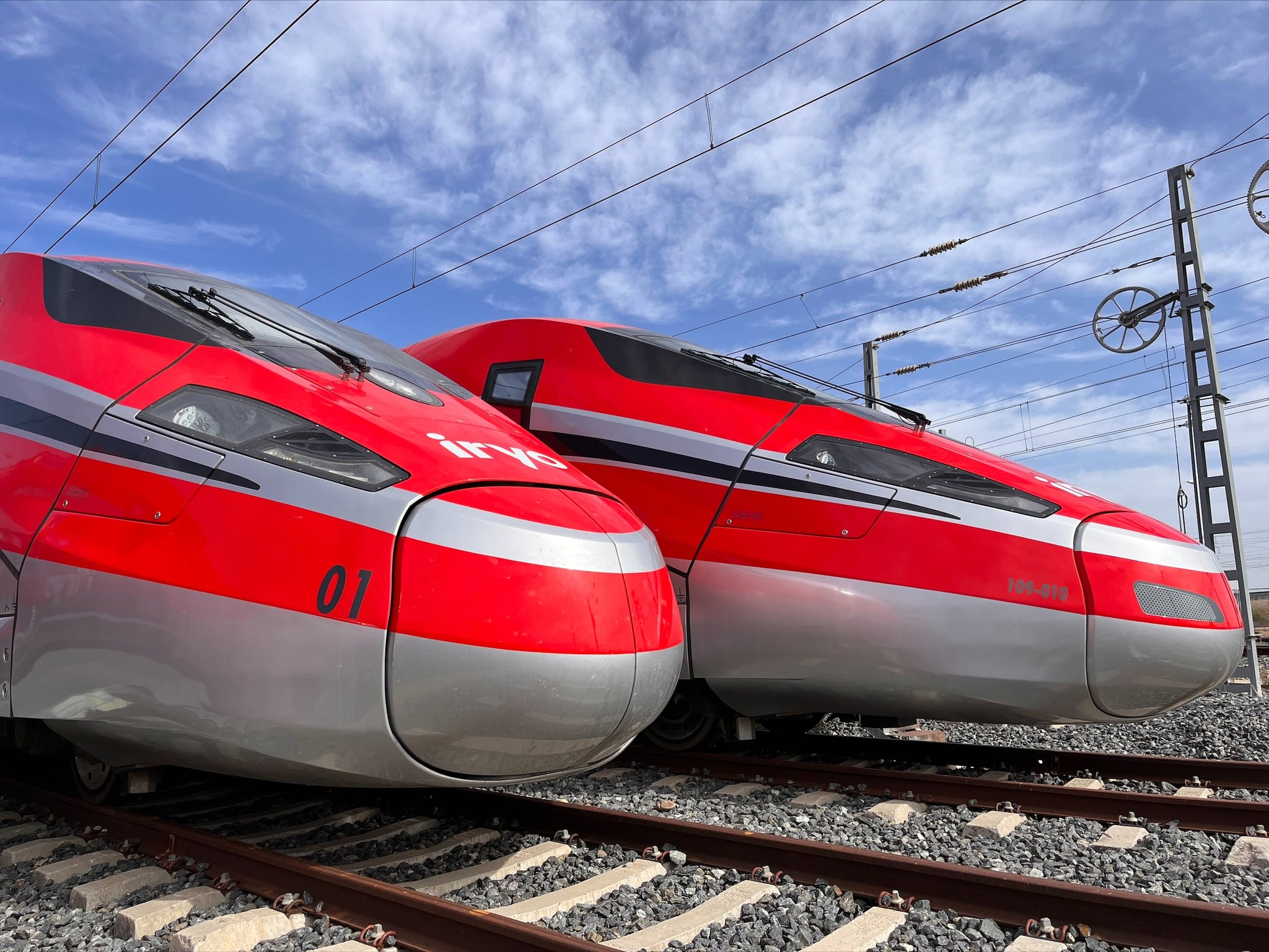
The Spanish railway network is in a state of profound shock following a series of consecutive accidents that have put the spotlight on track safety. The most serious incident, of a magnitude not seen in years, occurred last Sunday in Adamuz (Córdoba), where the derailment of a high-speed Iryo train led to a subsequent collision with an Alvia train, resulting in 45 fatalities. Almost simultaneously, two other incidents added to the tension: in Gelida (Barcelona), a commuter train derailed due to the collapse of a retaining wall, and in Cartagena, a narrow-gauge train collided with the arm of a crane that had encroached on the tracks, fortunately with less serious injuries.
The investigation into the Adamuz accident, the most complex and urgent, is progressing without firm conclusions but is already yielding revealing technical data. The Commission for the Investigation of Railway Accidents (CIAF) and Minister Óscar Puente have focused attention on unique marks or “bites” found on the left-side bogies (axles) of the stricken Iryo train. Puente admitted it was “an undeniable possibility” that this damage could be due to a defect in the track, noting that preceding trains also showed similar, albeit fainter, marks. This line of inquiry explores whether there was a break in the infrastructure, without yet determining if it was the cause or a consequence of the initial derailment.
Almost unanimously, authorities have preliminarily ruled out several hypotheses. Both the Ministry of Transport and Renfe have excluded human error and excessive speed, confirming that both trains were traveling between 200 and 210 km/h, below the section’s limit of 250 km/h. Minister Puente was emphatic in stating that “the human factor had no incidence here” and that the subsequent impact by the Alvia was unavoidable. He also firmly rejected any link between the accident and a lack of maintenance or investment in the tracks, asking to dissociate that debate from what happened.
While technical inquiries advance, other unofficial theories have circulated on social media. One, suggesting possible sabotage with explosives—comparing images from the site to incidents in Poland—has not been mentioned by authorities as a line of investigation. On the other hand, an old union request to reduce speed on that section was recalled, but its own promoters clarified it was a comfort issue, not safety, and data confirms the trains were not exceeding the established limit.
As the most urgent on-site phase concludes—with the location of the last two victims and the deactivation of the Territorial Emergency Plan in Andalusia—the investigation now enters a meticulous laboratory stage. Interior Minister Fernando Grande-Marlaska indicated that thousands of photographic pieces of evidence, videos, and data are being sent for analysis. Official statements emphasize the complexity of the case and call for patience, stressing that it will still take time to determine with certainty the chain of failures that led to this tragedy. The priority remains clarifying the origin of those enigmatic marks on the bogies, as various official digital publications here in Spain report.
Have any thoughts?
Share your reaction or leave a quick response — we’d love to hear what you think!
-
 0
0
-
 0
0
-
 0
0
-
 0
0
-
 0
0

2 comments
Experience the best PH889 online casino in the Philippines. Fast PH889 login, easy register, premium PH889 slot games, and official PH889 app download. Join PH889, the top online casino in the Philippines! Enjoy fast PH889 login, easy register, and premium PH889 slot games. Get the official PH889 app download now for a premium gaming experience. visit: ph889
[721]MWPlay Online Casino Philippines: Your Top Destination for MWPlay Slots. Quick MWPlay Login, Register, and App Download for the Best Gaming Experience. Experience the best of MWPlay Online Casino Philippines! Access premium MWPlay slots with a quick MWPlay login and easy MWPlay register process. Boost your gaming with the MWPlay app download for seamless play anytime, anywhere. Join the #1 destination for Filipino players today! visit: mwplay