
The transition to sustainable mobility faces a monumental challenge in the freight transport sector: energy. Limited range, long downtime for recharging, or the enormous cost and weight of batteries are barriers hindering the electrification of long-distance trucks. As the digital magazine Diario de Transporte has pointed out, efficiency and economic viability for the transporter’s pocket are key to ensuring this revolution doesn’t stall. It’s not just about manufacturing electric trucks, but about creating an ecosystem that makes them operational.
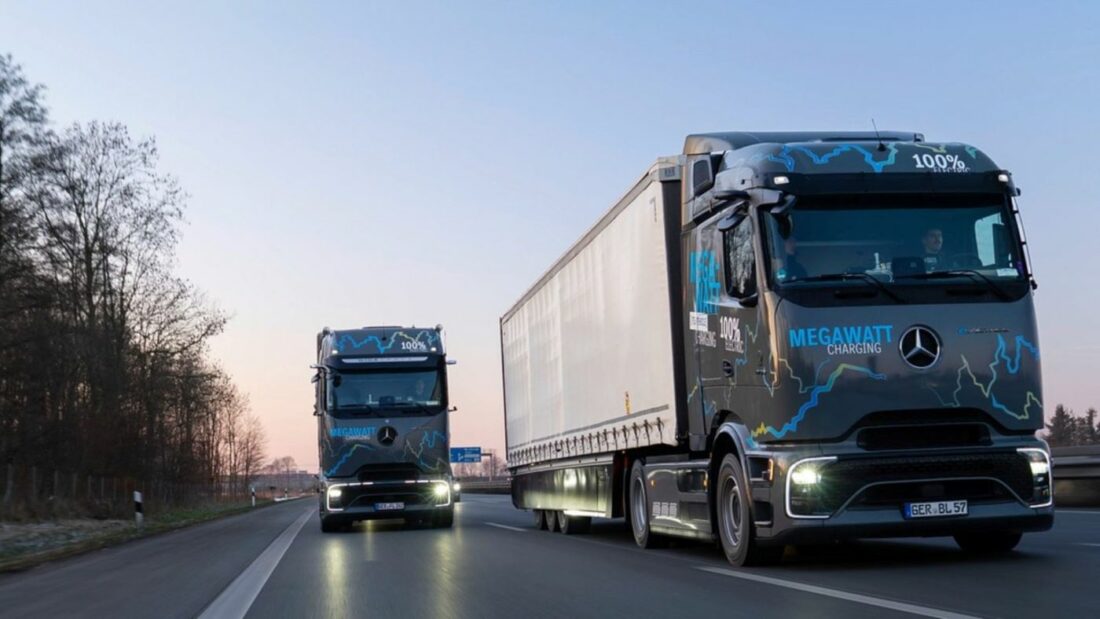
In this scenario, a new development is taking shape on European roads and could be a turning point. Mercedes-Benz Trucks is conducting a large-scale test with its long-distance electric truck, the eActros 600, focused on the Megawatt Charging System (MCS), an emerging standard that promises charging speeds as fast as those for passenger cars. The test, a 2,400-kilometer journey from Germany to Sweden, is not a mere trip, but a rolling test bed to validate the technology in real conditions, including the cold Nordic winter.
The goal is clear and goes beyond testing the truck’s endurance. It seeks to guarantee the optimal compatibility of the eActros 600 with megawatt charging stations from various manufacturers, a crucial aspect to avoid a “Tower of Babel” of plugs. Peter Ziegler, Director of Electric Charging Components at the brand, emphasizes that the technical challenge lies in harmonization and managing the extreme charging currents, which demand high-precision cooling. This real-life test is fundamental for polishing the system before its market launch.
The promised advantage is revolutionary: with a power of up to 1,000 kW, MCS can charge the eActros 600’s batteries from 20% to 80% in just 30 minutes, a time comparable to a driver’s mandatory break. This transforms the operational equation. As Diario de Transporte analyzes, such rapid recharging brings the productivity of the electric truck closer to that of diesel, allowing for more efficient and flexible logistical processes, provided the infrastructure keeps up.
The project has an essential collaborative vision. The MCS standard is being driven by the CharIN consortium, which brings together vehicle and infrastructure manufacturers, working towards a uniform interface. This cooperation is the only way to build a pan-European fast-charging network for trucks, a sine qua non requirement for international electric transport. The Mercedes-Benz test is, therefore, a practical step towards that standardization, providing invaluable data for all industry players.
In conclusion, Mercedes-Benz’s initiative goes beyond testing a new truck; it is testing the backbone of heavy transport electrification. If the MCS system proves its robustness and interoperability, it will have provided an answer to one of the major dilemmas: that of downtime. This not only reduces the economic risk for pioneering transporters but also brings closer a future where the decarbonization of road freight transport is, finally, an operational reality and not just an aspiration. The race for electrification has entered the decisive infrastructure phase.
Have any thoughts?
Share your reaction or leave a quick response — we’d love to hear what you think!
-
 0
0
-
 0
0
-
 0
0
-
 0
0
-
 0
0
