
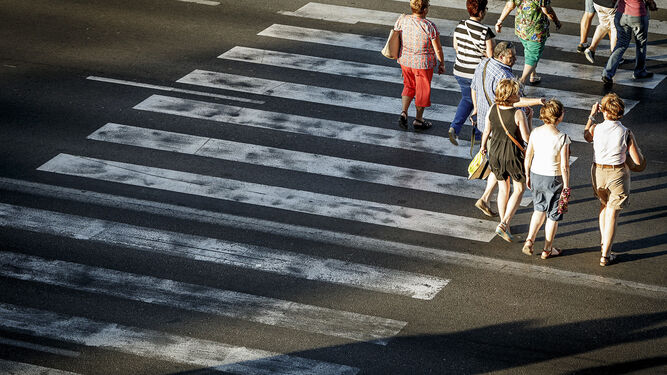
The hurry of the walker, and the space that is no longer theirs…
It sounds like the plot of an urban satire, but it’s real: since January 2026, Slovakia has imposed a 6 km/h speed limit for pedestrians on its sidewalks. This measure, unprecedented in Europe, makes us smile when we imagine radars measuring the pace of a hurried passerby, but it also invites serious reflection. In a world where public space is increasingly contested, is this an absurd solution or a symptom of a real problem? The Slovak rule, although difficult to enforce, reveals the growing tension on our sidewalks, where the traditional stroll competes with invading electric scooters and bicycles.
Let’s look at the numbers: a healthy person aged 18 to 50 walks at an average speed of 4 to 6 km/h, so, in theory, most would not break the limit. The law’s true target is not the common walker, but rather those behaviors that generate conflict: urban runners, people rushing through crowds, or, above all, coexistence with personal mobility vehicles. Herein lies the first blind spot: the measure seems to want to solve a coexistence problem between different actors (pedestrians vs. light vehicles) by penalizing the slower one, instead of clearly defining where each should circulate.
The bureaucratic absurdity shines through when we try to visualize its practical application. Will officers carry hand-held radars? Will we have apps alerting us if we exceed the pace? It’s almost humorous to think of the perfect fine: “Madam, you were going 6.5 km/h fleeing a bus that wasn’t stopping.”
The situation is reminiscent of the anecdote about Esteban the computer scientist and his hyper-optimized smartphone: in our obsession to measure and control everything, even the most natural act, walking, becomes subject to excessive regulation. Modernity sometimes leads us to solutions that are as high-tech as they are ridiculous.
I’ve been imagining the future this law suggests: will we end up wearing odometers on our shoes? Will there be “sole radars” camouflaged in the cobblestones? The absurdity helps us question: instead of fining the pedestrian for their legitimate haste, why not redesign the streets so that this haste is neither dangerous nor a nuisance?
Beyond the anecdote, the Slovak rule hits the nail on the head of a genuine problem in many large cities, including Spanish ones. The pedestrian, the weakest link in urban mobility, “always loses out,” not because of speeding, but due to the invasion of their space and the lack of real protection.
Instead of picturesque speed limits, what is needed is a clear regulatory distinction between vehicles (bikes, scooters) and pedestrians, with well-defined and safe spaces for the latter.
In conclusion, the measure is more of a legislative performance than an effective solution. However, its value lies in having achieved what it perhaps intended: to open the debate and draw attention to the chaotic coexistence on sidewalks.
Let’s have fun with the surrealism of fining for fast walking, but let’s not lose sight of the core issue: the need to design cities for people, where pedestrians can move safely, peacefully, and, yes, at the speed their haste or stroll allows, without competing with motorized wheels.
In the end, the true folly is not the walker’s haste, but having to legislate it because the space that rightfully belongs to them has ceased to be theirs.
Have any thoughts?
Share your reaction or leave a quick response — we’d love to hear what you think!
-
 0
0
-
 0
0
-
 0
0
-
 0
0
-
 0
0
