
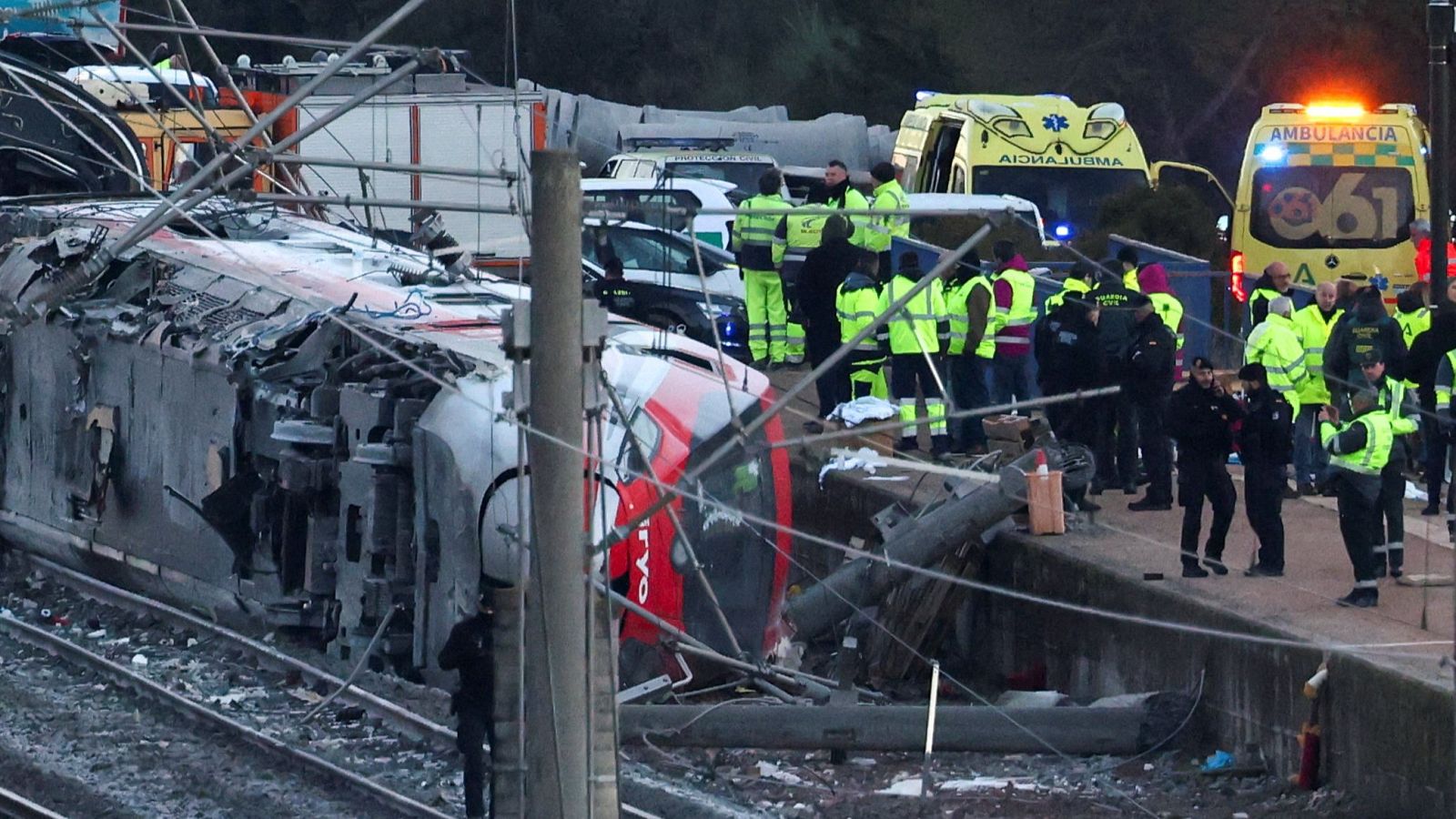
The final death toll of the tragic train accident in Adamuz (Córdoba) remains, on this Tuesday, at 41 people, confirmed by the authorities. The arduous work of the rescue teams continues unabated, as demonstrated by the recovery on this same day of three of the bodies that were still inside the stricken convoy, a task that required the use of heavy machinery.
This already appalling toll is compounded by the anguish of the 43 missing persons reports filed, some of which may correspond to victims already located but pending identification.
Alongside the grief, uncertainty about the condition of the survivors marks the day. According to the latest information, 39 people remain hospitalized as a result of the accident, 13 of whom are in critical condition in intensive care units (ICU). This human dimension of the catastrophe, with dozens of shattered families and injured people fighting for their lives, centers the nation’s pain, a sentiment joined by King Felipe VI and Queen Letizia in their visit to Córdoba, recognizing the “collective effort” of all responders.
Amid the sorrow, the investigation to determine the causes is advancing with utmost caution. As declared by the Minister of the Interior, Fernando Grande-Marlaska, after the Council of Ministers, “all hypotheses are open.” The technicians are not yet leaning towards a possible failure of the track or of the train itself, the Iryo Málaga-Madrid that initially derailed. The investigative commission has already begun inspections at the site and has determined that it will be necessary to analyze the rails and the train’s running gear in a laboratory, a meticulous process that will take time.
In parallel, and as an extreme precautionary measure, traffic on the affected high-speed lines remains suspended. The railway administrator, Adif, has indicated that it will not be able to assess the damage to the infrastructure nor, therefore, proceed with any repair or renewal until the police and judicial examinations in the area are concluded. This decision, although impactful for connectivity, underscores the absolute priority given to the investigation to avoid any future risk.
Thus, Spain faces a day marked by mourning and the search for answers. While high-tech teams and canine tracking units continue to work at the site, society watches with pain as a modern infrastructure, which according to Adif underwent a recent renovation and exhaustive checks just two months ago, has been the scene of one of the worst rail tragedies in recent decades. The King’s words resonate starkly: “However good the infrastructure may be, there are accidents. This one has been very tragic.” The entire nation stands with the victims and awaits, with patience and rigor, the conclusions that will prevent such a tragedy from happening again.
Have any thoughts?
Share your reaction or leave a quick response — we’d love to hear what you think!
-
 0
0
-
 0
0
-
 0
0
-
 0
0
-
 0
0
