
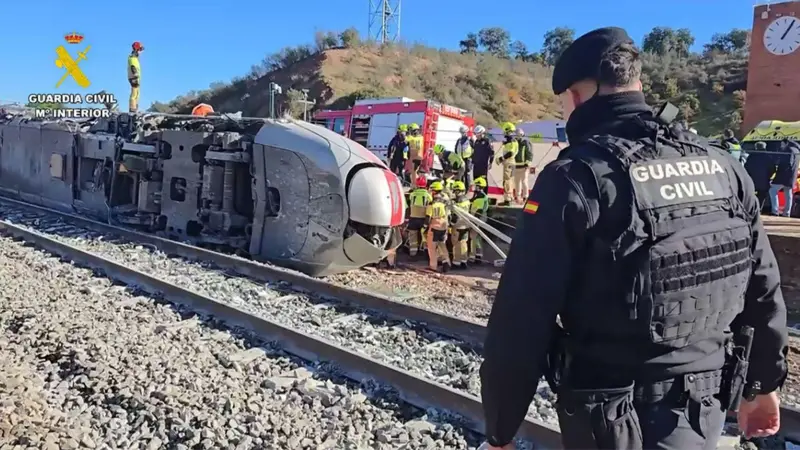
ADAMUZ (CÓRDOBA). – Rescue and victim location operations continued this Monday on the high-speed section in Adamuz (Córdoba), following Sunday’s devastating train accident that claimed at least 39 lives and left over 150 injured. To their families, friends, and colleagues, we extend our deepest condolences.
Emergency teams are working against the clock in a scene described as “Dantesque” to ensure no one remains trapped in the twisted metal of the carriages, some of which fell down a several-meter-high embankment.
The human toll of the tragedy is still provisional, and authorities warn the death count could rise. “We had to remove a deceased person to reach someone alive. It is hard and delicate work,” stated the head of the Córdoba fire department, Francisco Carmona, to RTVE. The violence of the accident is such that, according to Andalusian President Juanma Moreno, some bodies “are hardly recognizable” and DNA tests will be required for identification. Currently, 43 people remain hospitalized, 12 of them in critical condition in the ICU, including five minors.
The catastrophe unfolded around 19:45 when the last three carriages of an Iryo train traveling from Málaga to Madrid derailed on a straight section. These derailed carriages collided with a high-speed Alvia train operated by Renfe traveling in the opposite direction (Madrid-Huelva) on the adjacent track. The impact, occurring at approximately 200 km/h, caused the first two carriages of the Renfe train to also derail and plunge down the embankment, worsening the scale of the tragedy.
Witnesses to the hellish scene recounted moments of terror. “Some people were okay and others very badly. And we had them in front of us, we were seeing them die but couldn’t do anything,” Ana, a passenger on the Iryo train, told media at the scene. Another survivor, Lucas Meriako, described it as a “horror movie,” with extreme vibrations and a subsequent impact that made him think “the whole train was going to fall.”
The Minister of Transport, Óscar Puente, called the accident “extremely strange,” given the modernity of the trains involved – the Iryo one was practically new – and the recent renewal works on that line, completed last May. While the Railway Accident Investigation Commission (CIAF) takes over the investigation, authorities urge caution and avoid speculating on the causes. The president of Renfe, Álvaro Fernández Heredia, pointed out on Cadena SER that the narrow 20-second interval between the passing of the two trains likely prevented the automatic safety systems from activating.
The tragedy, the most serious on the Spanish railway in the last decade, has interrupted high-speed traffic between Andalusia and Madrid, a vital connection that could take weeks to fully normalize, as an entire country confronts the heartbreaking images from its safest and most extensive network in Europe.
With information from BBC News Mundo, 20 Minutos, and official statements from the Andalusian Emergency Agency, Ministry of Transport, and RTVE.
Have any thoughts?
Share your reaction or leave a quick response — we’d love to hear what you think!
-
 0
0
-
 0
0
-
 0
0
-
 0
0
-
 0
0
