
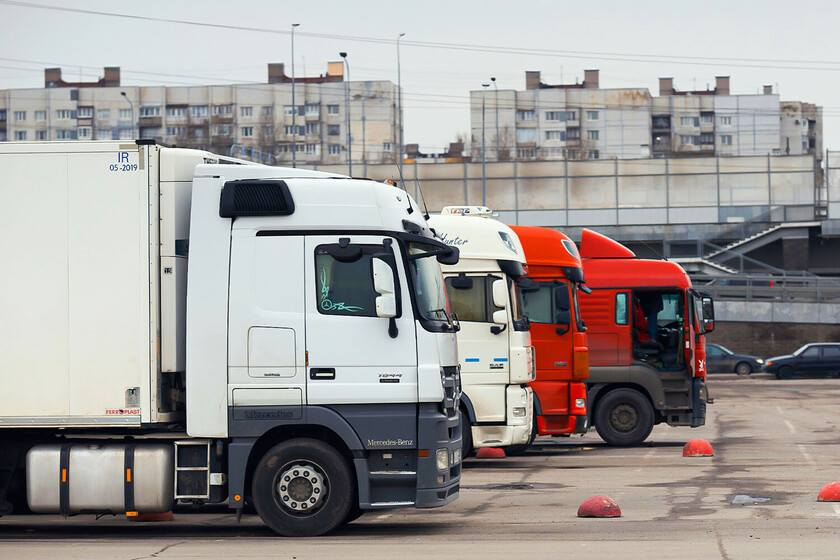
Imagine that the roads are the arteries of commerce. Now imagine that those arteries begin to collapse not due to traffic, but due to the absence of those who drive the vehicles that give them life. This is not a dystopian scenario, but the harsh reality facing Europe and, with particular severity, Spain. Three out of every four tons of goods, and 85% of the perishable products that fill our supermarkets, travel in trucks that are finding it increasingly difficult to find hands on the wheel. The International Road Transport Union (IRU) paints an alarming picture: a deficit of 3.6 million drivers globally, with Europe on track to lack one million professionals by 2026. Spain, for its part, already has a gap of 30,000 unfilled positions, an early symptom of a systemic disease.
The problem is not cyclical, but structural and demographic. We are witnessing the “massive retirement” of a generation that sustained the sector. In Europe, the average age of a driver is around 47; in Spain it exceeds 50, with half of the workforce over 55. The IRU estimates that about 3.4 million continental truckers will hang up their steering wheels in the coming years, creating a void that the pipeline of new drivers is unable to fill. Globally, less than 12% of drivers are under 25; in Europe that percentage plummets to 5%, and in countries like Spain or Poland, it barely reaches 3%. The profession, perceived as demanding and with often tough working conditions, does not appeal to the young.
This perfect storm—mass retirements, lack of replacement, and an unstoppable boom in online commerce that drives up demand—threatens to turn scarcity into collapse. If decisive action is not taken, the forecasts darken even further: by 2028, the global deficit could exceed seven million. Umberto de Pretto, Secretary General of the IRU, has already issued a stern warning: “This demographic time bomb will explode,” hindering economic growth and competitiveness. The immediate result foreseen by hauliers is ghost routes, chronically delayed deliveries, and unsustainable pressure on transport costs, which will inevitably be passed on to final prices.
Faced with this abyss, institutional responses seem, for now, insufficient. Some governments, like Spain’s, have begun to make moves with grants of up to 3,000 euros to obtain C and D licenses (truck and bus). A commendable patch but clearly incapable, on its own, of reversing a trend of such magnitude. The core of the dilemma lies in the profession itself: sector studies, such as that by the platform TDRJobs, indicate that driver turnover is mainly due to the demand for better salaries (24.3%) and working conditions (22.1%). Attracting new talent requires reinventing the trade, improving work-life balance, safety, and the social image of a job that is, literally, the lifeblood of our supply chains.
The outlook for 2026 is, therefore, one of growing uncertainty. No tipping point is in sight to correct the imbalance in the short term. Instead, an era of constant logistical tension is looming, where the resilience of economies will depend on their ability to make the profession more attractive, promote intermodality (combining train and truck), and digitalize processes to optimize resources. Spain, with its strategic position as Europe’s southern gateway and a thriving agri-food sector, is particularly vulnerable if it fails to stem its haemorrhage of professionals.
The truck remains, and will remain for decades, the backbone of our consumption model. However, that backbone shows serious symptoms of arthritis. The driver crisis is much more than a sectoral problem; it is a stress test for our way of life. We face a clear choice: act decisively to revalue an essential profession or accept that the flow of goods we take for granted may begin to fail, with consequences that will resonate on every empty shelf and in every bill we pay. The road to 2026 is paved with good intentions, but it is urgent to step on the accelerator of solutions.
Have any thoughts?
Share your reaction or leave a quick response — we’d love to hear what you think!
-
 0
0
-
 0
0
-
 0
0
-
 0
0
-
 0
0
