
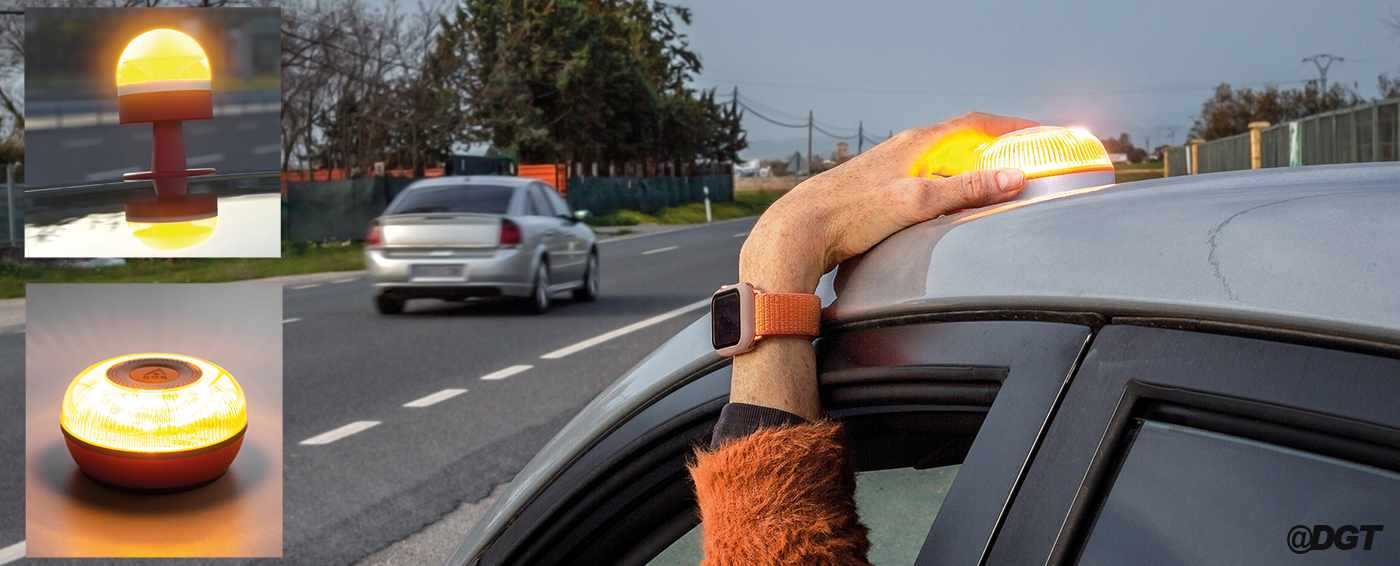
As of January 1, 2026, Spanish transporters and all other drivers will take a definitive step towards safer and more technological roads. The traditional warning triangles will become obsolete, replaced by the connected V-16 beacon. This regulatory change, driven by the Directorate-General for Traffic (DGT), aims to eliminate one of the highest-risk moments: exiting the vehicle to place the warning signs. For the transport sector, accustomed to long hours on roads and motorways, this innovation is not a mere update but a crucial tool to protect drivers’ lives.
What is the V-16 beacon and how does it work? It is a compact self-contained yellow light device that, in an emergency, is preferably placed on the vehicle’s roof with a magnet. Its high-intensity flashing light visually alerts other users. However, its true revolution is connectivity. Inside, it contains a GPS chip and a SIM card that, when activated, sends the exact location of the incident in real time to the DGT 3.0 platform. This information is transmitted to variable message signs on the road and navigation applications, proactively warning drivers approaching the danger point.
The advantages for the transport professional are evident. The main one is safety: the risk of being run over is eliminated as there is no need to walk on the roadway. Furthermore, signaling is immediate (activated in seconds from the glove compartment) and more effective in low-visibility conditions. It is important to note that the homologated beacon must offer a minimum connectivity of 12 years without additional fees, and its battery must have an autonomy of at least 18 months. It does not replace the emergency call (eCall), but it complements the response by automatically geo-locating the incident.
Homologation and acquisition: keys to a safe purchase. Not all beacons on the market will comply with the regulation from 2026. It is essential to purchase a model certified as a “connected V-16” and verify its presence on the official DGT list. To facilitate this process for transporters, the Spanish Confederation of Freight Transport (CETM) has established an agreement guaranteeing its members access to homologated devices, meeting all quality, safety, and regulatory requirements. Interested parties can place their orders through their provincial associations.
In short, the transition to the V-16 beacon represents a mandatory and beneficial modernization. For the transporter, it means equipping themselves with a technological ally that protects their physical integrity, streamlines incident management, and contributes to collective road safety. The recommendation is clear: get informed through official channels like the DGT and sectoral organizations like the CETM, and proceed to acquire a certified device well before the mandatory requirement comes into force, thus ensuring a safe and hitch-free transition.
Have any thoughts?
Share your reaction or leave a quick response — we’d love to hear what you think!
-
 0
0
-
 0
0
-
 0
0
-
 0
0
-
 0
0
